Introduction | A translation you can understand and a translation you can use are two different things. The former solves “I can’t understand it,” while the latter requires consistent terminology, untouched symbols, and matching structure—because a translation is often not the endpoint, but the raw material for the next step of work.
1. Language barriers are the easiest to underestimate
In the same research field, not all results are published in English-language journals. Work published in German, Japanese, Russian, Portuguese, or Spanish is often skipped because “I can’t understand it”—and when enough people skip it, that work effectively ceases to exist.
Clearing the language layer first is the prerequisite for judgment to come into play.
2. Twelve common research languages can be translated into one another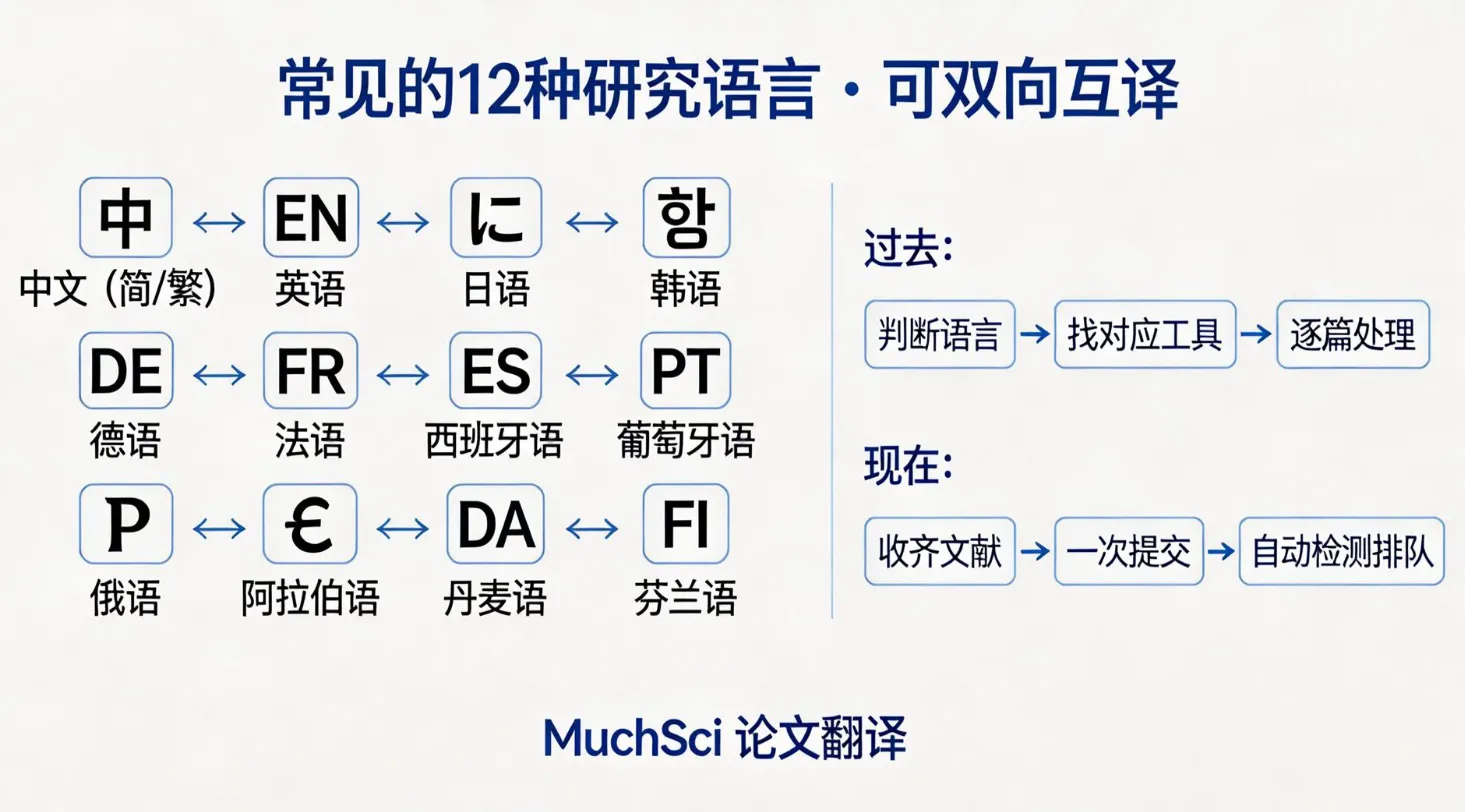
MuchSci Paper Translation supports mutual translation among 12 languages: Chinese (Simplified/Traditional), English, Japanese, Korean, German, French, Spanish, Portuguese, Russian, Arabic, Danish, and Finnish. The source language is automatically detected upon submission. You don’t need to first determine “which country’s language this is,” nor do you need to find the corresponding translation tool—submit once, and papers are processed one by one in a queue.
For cross-language research, this step changes the workflow: in the past it was “first determine the language, then find a way to read it”; now it is “first collect the literature, then hand it all over to it.”
3. To make a translation “usable,” four things must be preserved
Reading smoothly does not mean it is usable. What truly determines the value of a translation is whether the details have been preserved:
| Element in the paper | How to handle it during translation | Why |
| Body paragraphs | Translate paragraph by paragraph in correspondence | Makes side-by-side comparison easier and avoids disruption from reflow |
| Technical terms | Keep consistent throughout; retain the original English term when necessary | If terminology is inconsistent, later data extraction will go wrong |
| Figures, tables, and formulas | Keep as is; translate only titles and captions | Numbers and symbols must not be changed |
| References | Keep the original entries | Authors, journals, and years do not need translation |
| Abstract and conclusion | Translate first | First judge whether this paper is worth a close read |
The most error-prone areas are terminology and symbols: a passage may read very smoothly, but if “modification” and “doping” are used interchangeably, or units are written differently, later comparisons will be distorted.
4. Translation is only an intermediate stop
If you treat the translation as the endpoint, you usually read it once and set it aside; if you treat it as an intermediate stop, things are different: the original PDF becomes an editable translation txt, then methods, metrics, and conclusions are extracted from the translation, and finally consolidated into comparison tables or review materials for the same field.
In actual work, this step is often explicitly requested. For example, when submitting a translation, one might add, “After translation is complete, please extract the core data on modification methods”—doing translation and extraction in sequence saves much more effort than finishing the translation first and then going back to look for it.
5. Not every paper is worth translating in full
Translation capability solves “understanding,” not “whether to read.” A more time-saving approach is: first read the abstract and conclusion to judge relevance; for relevant papers, translate key sections first and request the full text only when details are needed; for irrelevant ones, just note the title and conclusion.
Translating more does not mean reading more. Leaving time for the few papers that are truly relevant—that is efficiency.
6. The endpoint of translation is judgment
Looking back, the path for a paper to go from a foreign language to being usable is clear: first cross the language barrier (automatic detection, unified target language, processing one paper at a time), then preserve the details (consistent terminology, untouched symbols, matching structure), and finally move into extraction and comparison.
MuchSci Paper Translation handles the earlier part—turning multilingual, multi-document translation into something you rarely need to worry about, and returning the results as text you can continue editing. As for which paper is worth a close read, which data should be extracted, and whether the conclusions can support your judgment—that is still your job.
The only criterion for judging a translation is actually quite simple: if you hand it to the next person, can they use it directly for the next step? If yes, then the translation is complete.