How I put together my course paper draft in the 48 hours before the deadline
Three midterms collided on Wednesday, and one of them required a 3,000-word course paper. I had set the topic two weeks earlier, opened the document seven or eight times, and the body was still empty.
It wasn’t that I didn’t have time; I just didn’t know which sentence to start with.
Later I split those 48 hours into four blocks, each producing only one thing. That time I started writing at 8 p.m. on Thursday and submitted the draft on Saturday afternoon.
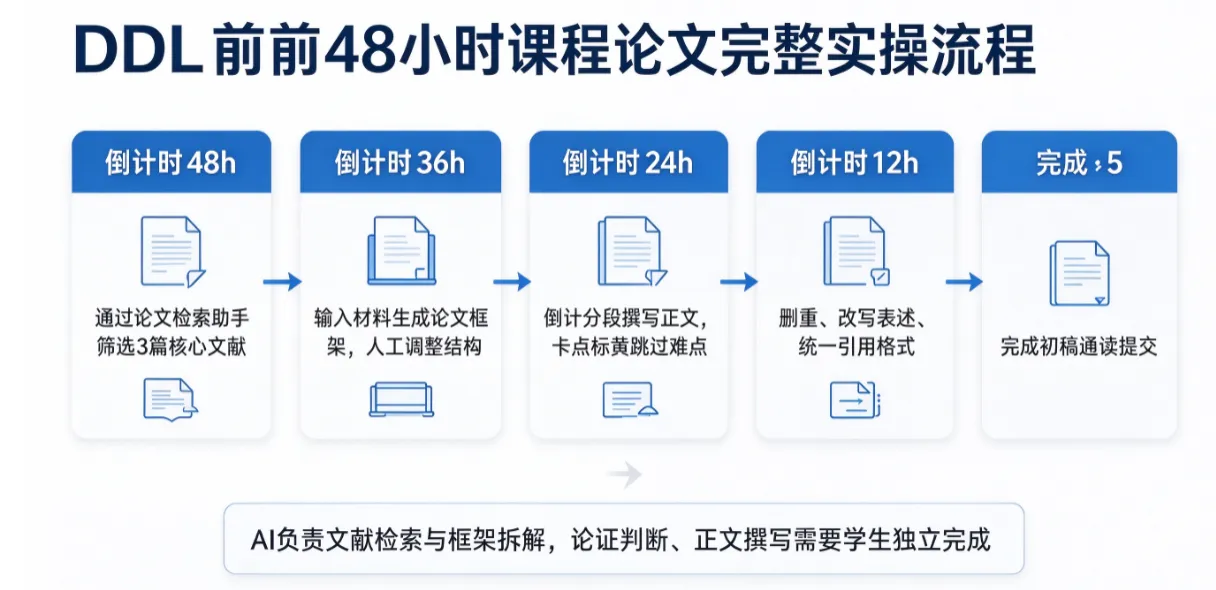
Countdown 48 hours: first find three sources that can support the structure
My initial mistake was “find ten first.” After reading ten, I had ten directions in my head, and it was even harder to write.
Now I only look for three, each with a role:
· One review, to see which schools this topic is divided into;
· One empirical study on the same topic, to see how others organize their arguments;
· One methodological source, to see what the method I plan to use originally looked like.
To find these three, I used MuchSci’s paper search assistant, filtered the last five years by keywords, looked at titles and abstracts first, and only clicked into ones that matched. Its library contains 180 million Crossref papers, searchable by title, author, and DOI, which was faster than switching keywords back and forth across several databases.
Once the three were settled, I wrote one sentence on paper: what this paper is trying to prove. If I couldn’t write that sentence, it meant I hadn’t found the right sources yet.
Countdown 36 hours: get the framework down first; the sentences will follow
I gave the abstracts of the three papers, my topic, and that sentence about “what to prove” to MuchSci’s Paper Sailor, and asked it to give me a three-part framework: argument, evidence, and possible counterarguments.
I usually change only two things in the framework it returns: shorten the “background” section and move the “counterargument” section earlier. I basically use the remaining subheadings as they are.
The use of this step is very practical: once the framework is fixed, writing becomes filling in the blanks. I no longer have to think about structure and sentences at the same time.
The official website says, “Just propose the research question; leave execution to MuchSci.” My understanding is that it is responsible for breaking the question into actions, while judging whether the framework can hold up is still my job—so for the framework I only use the structure, not the sentences it writes.
Countdown 24 hours: one paragraph per page; if stuck, highlight it yellow
The rule I set for myself was: stop when a paragraph fills a page, and don’t go back to revise.
For each paragraph, first write a claim, then add two pieces of evidence, and finally write a “therefore” sentence. Three sentences hold up a paragraph, with examples filled in between.
Where I couldn’t write, I didn’t force it; I highlighted it yellow and skipped it, then wrote the next paragraph. There are usually only two or three highlighted spots, and handling them together at the end is much faster than getting stuck midway.
Countdown 12 hours: do only three finishing tasks
1. **Delete repeated points.** Where the same thing is said twice, keep the place with stronger evidence.
2. **Replace “I think” with statements that have support.** Either connect it to literature, connect it to data, or explicitly write it as “my speculation.”
3. **Unify the citation format.** I fix this all at once, not while writing.
After finishing these three, read through once, and submit.
 What I only understood later
Writing 3,000 words in one evening wasn’t because I wrote fast; it was because the previous 36 hours had locked down “what to write.” What really held me back was never typing speed, but having to decide all over again “what this paragraph should say” every time I opened the document.
This is also my basic way of using an AI assistant for college students now: leave the step of “deciding what to write” to search and frameworks, and keep “what it turns out like” for myself. I usually open MuchSci in just two places—when finding those three sources, and when building the framework.